TL;DR: Conn3x shipped v0.23.0 today. We're 59 days from our target for full IaCC: everything you'd reach for Terraform and Ansible to do, in one tool, one plan and one state. It's built for a homelab and for a data centre with thousands of servers. What it needs most now isn't code. It's people using it, and stars on GitHub. It takes one click and it matters more than you'd think.
First, What’s IaCC?
Two tools, two states, and you in the middle
If you run infrastructure today, you probably run two tools. Terraform or OpenTofu builds the servers. Then Ansible logs in and configures them. Two runs, two states, two languages, and you’re the glue between them, copying IP addresses from one into the other and hoping nobody changed anything by hand in the middle.
IaCC is my shorthand for infrastructure as code and configuration. One tool, one plan, for the cloud and for what’s on every server it creates. Conn3x is a fork of OpenTofu that does both. You write a circuit next to your OpenTofu code: the hosts, how to log in, and the steps each one needs, such as packages, files, users and services. Then conn3x plan shows you every change, in the cloud and on every host, before anything happens. conn3x apply does it, and conn3x drift tells you what someone changed by hand since.
“Full IaCC” means Conn3x covers the jobs people use both tools for, so nobody has to keep the second one around.
Where We Are
v0.23.0, out today
Today’s release is v0.23.0. A few things in it, and in the releases just before it:
- Containers as hosts. Point a circuit at a Podman, Docker or Kubernetes container and Conn3x runs every command through
exec. There’s no sshd to set up and no keys to manage. It’s the fastest way to test a circuit, and it’s experimental for now. - Safer edits to the files that can lock you out. The
line,blockand other edit steps can now check a file before it replaces the old one. Runsshd -ton the newsshd_configfirst, and a typo never reaches the server. - Converting Ansible roles.
conn3x convert ansibleturns roles into circuits. It converts a task only when it can show the result does what Ansible does, and leaves the rest with a note saying why. On fifteen popular Galaxy roles, v0.23.0 converts 61 tasks, up from 38 two releases ago. What’s on main today converts 86. - A web UI. It covers plans and applies from the browser, roles, single sign-on, scheduled drift checks that can put things back, and a searchable store of every host’s facts and every step’s result.
Yes, It’s for the Big Shops Too
I'd rather show you than tell you
I started Conn3x on a homelab. I’m building it for the people running thousands of machines too, and I’d rather show you than tell you:
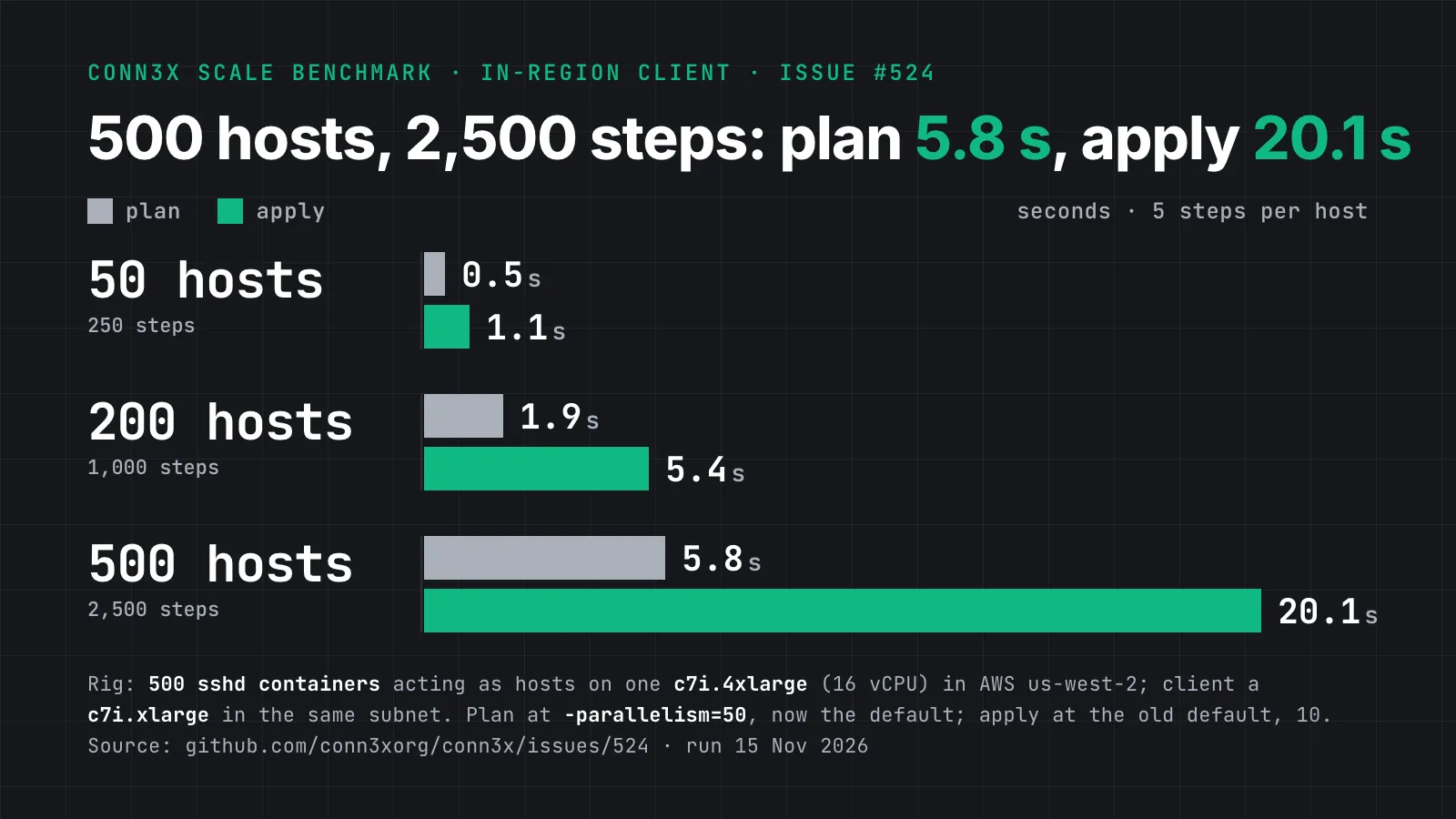
- Scale, measured. Our benchmark plans 500 hosts at once, 2,500 steps, with the hosts running in AWS. From a machine in the same region, that plan took 5.8 seconds, and applying it took 20.1. The numbers and the setup are public on GitHub, and performance changes get measured against them.
- Windows and Active Directory. Windows Server steps can build a domain, promote domain controllers, and configure member servers in the same plan as the VMs they run on. It’s in preview, tested on Azure.
- Network gear. Arista EOS, Cisco IOS, Juniper Junos and VyOS, over their own command lines, with a dry run before every commit. These are experimental, and we’re looking for people with real switches to test them.
- A web UI your security team can live with. It has roles per project, sign-in through your identity provider, an audit log, and drift checks on a schedule.
Read the chart as text
- 50 hosts (250 steps): plan 0.5 s, apply 1.1 s.
- 200 hosts (1,000 steps): plan 1.9 s, apply 5.4 s.
- 500 hosts (2,500 steps): plan 5.8 s, apply 20.1 s.
- Five steps per host, one per module. The client sits in the same subnet as the hosts (“in-region”), plan ran at
-parallelism=50, the default since v0.20.0, and apply at the old default of 10. - The rig: 500 sshd containers acting as hosts on one c7i.4xlarge (16 vCPU) in AWS us-west-2, with a c7i.xlarge (4 vCPU) as the client. Source: conn3xorg/conn3x issue #524, run 15 Nov 2026.
What’s coming gets measured the same way. If I can’t show a number or a test run, it doesn’t go on the website.
What’s Left, and How Long
32 issues and a date
The plan to full IaCC is thirteen themes, tracked as milestones on GitHub. Right now that’s 157 issues closed and 32 open. What’s left, roughly:
- Ecosystem: a searchable registry of circuits, and an editor that knows your circuits as you type. The VS Code extension already has completion and hover docs; a language server comes next.
- Event-driven runs: start a run from a webhook or an alert, not only from a person or a schedule.
- Rolling updates: the last pieces for updating a big fleet a batch at a time.
- The web UI: a sandbox for every run on Linux (built and merged, out in the next UI release), more sign-in providers, and API tokens.
- Policy, secrets and testing: a few recipes and checks, plus more people trying the preview features on their own hardware.
The target is 15 January 2027. That’s 59 days from today. It’s a target, not a promise carved in stone, and if it slips I’ll say so here first. “Full IaCC” means feature-complete as a preview. Calling it stable comes after real people have run it on real infrastructure for a while, which brings me to you.
Where I Need You
The part I can't write code for
This is where I have to be honest. I know how to build cool Sh!t. Everything else about being an open-source maintainer, I’m learning as we grow. This month alone I’ve learned what a CLA bot wants from me, that signing a git tag is its own small adventure, and that Homebrew has “notability” thresholds, which is a polite way of saying a package manager can decide you’re not famous enough yet.
Which brings me to the ask. Conn3x has 9 stars on GitHub. Nine. I’ve seen more stars on a cloudy night.
Stars aren’t vanity here. They gate real things:
brew install conn3x. Today it’sbrew install conn3xorg/tap/conn3x, from our own tap. Getting into Homebrew’s main list, so it’s justbrew install conn3x, takes 225 stars when the maintainer submits it. That’s our next big number.- Joining the CNCF. We plan to apply to the Cloud Native Computing Foundation’s Sandbox in spring 2027. The CNCF is part of the Linux Foundation, which is also where OpenTofu, the project Conn3x is built on, lives. A neutral home means Conn3x doesn’t depend on any one company, and that’s what makes it safe for a big organisation to bet on. When we apply, people will want to see that it’s used, and stars are the quickest public sign of that.
Read the graphic as text
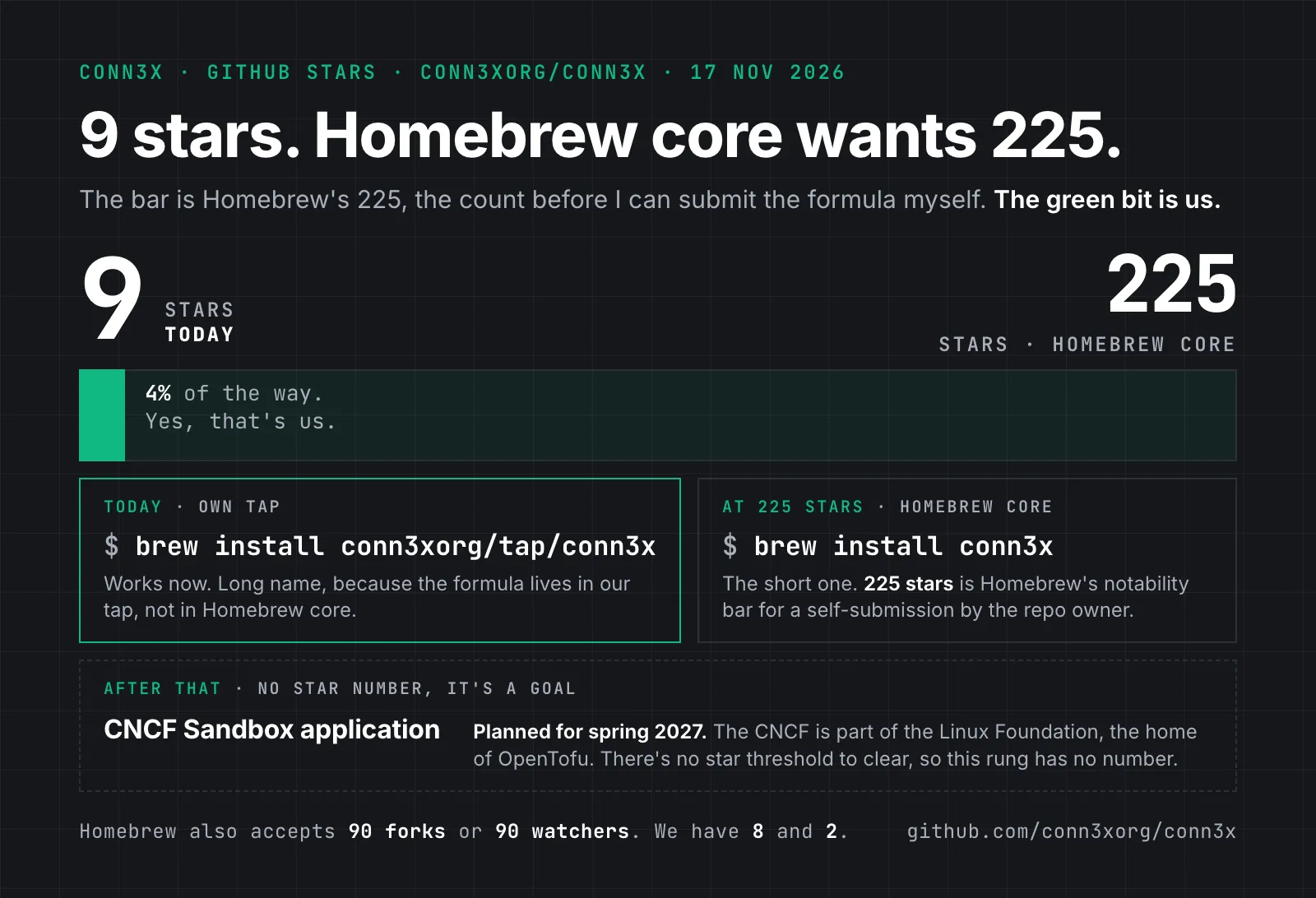
- Today: 9 GitHub stars on conn3xorg/conn3x (17 Nov 2026). The install is
brew install conn3xorg/tap/conn3x, the long name because the formula lives in our own tap, not in Homebrew core. - At 225 stars:
brew install conn3x. 225 stars is Homebrew core’s notability bar for a formula the repo owner submits themselves. 9 is 4% of 225, and the bar in the graphic is drawn to that scale. - After that, no star number because it is a goal, not a threshold: a CNCF Sandbox application, planned for spring 2027. The CNCF is part of the Linux Foundation, also home to OpenTofu.
- Footnote: Homebrew also accepts 90 forks or 90 watchers instead of 225 stars. We have 8 forks and 2 watchers.
So here’s what would help most, in order:
- Star Conn3x on GitHub. One click. It’s free, and it moves us towards both goals above.
- Try it in five minutes. Install it with
brew install conn3xorg/tap/conn3x, or from the apt and dnf repositories, then follow Get started. If you have Podman or Docker, thetry-it-locallyexample in the repo starts a throwaway server for you, so you can plan, apply and break things without touching anything real.
If you try it and something’s confusing, broken or missing, that’s useful too. The community page is where to find us.
What Happens Next
Updates here, until 15 January
I’ll keep shipping, and I’ll post here as we get closer to 15 January: what landed, what slipped, and how far we are from 225 stars.
If you’ve read this far, you’re exactly the person I’m hoping will click that star. Go on.
Share